Ceiling joists were never designed to manage the concentrated, static weight of a fully loaded steel rack without precise weight distribution across multiple structural members. Most failures in overhead storage aren't caused by the steel snapping, but by the slow pull of fasteners or the invisible fatigue of support brackets under cyclic loading. When you hang hundreds of pounds over your vehicle or workspace, the engineering of the mounting interface becomes the most critical safety variable in your garage. Selecting the right hardware requires a cold-eyed look at your ceiling's substrate and the shear strength of the lag bolts provided by the manufacturer. We analyze these mechanical vulnerabilities so you can identify which systems offer the structural redundancy necessary for long-term overhead safety.
Ceiling-mounted racks
Maximize your storage space and keep your belongings organized out of the way
Product List
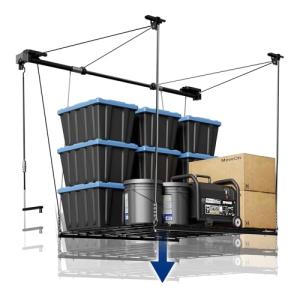
Heavy-Duty Overhead Storage Rack
Fleximounts
Product Review Score
4.95 out of 5 stars
133 reviews$259.99 $179.99
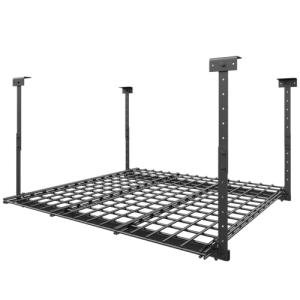
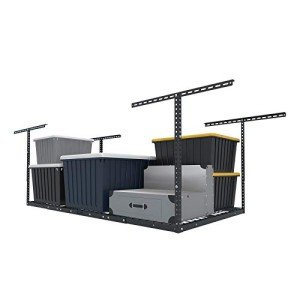
Adjustable Overhead Garage Rack
Fleximounts
Product Review Score
4.36 out of 5 stars
73 reviews$159.99 $109.99
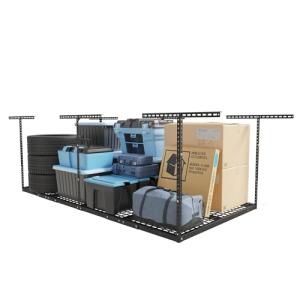
Adjustable Garage Storage Rack
Fleximounts
Product Review Score
4.39 out of 5 stars
8 reviews$194.99 $145.99
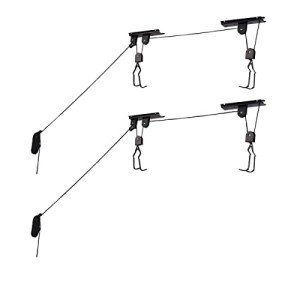
Bike Hoist Storage Lift 2-Pack
Rad Cycle Products
Product Review Score
4.56 out of 5 stars
225 reviews$27.40
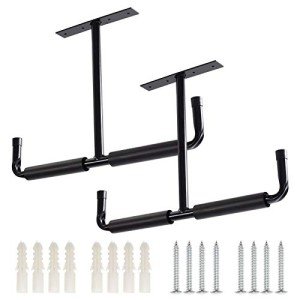
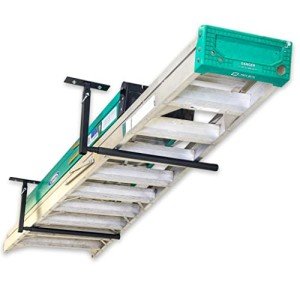
Ceiling Rack for Garage Storage
Storeyourboard
Product Review Score
4.89 out of 5 stars
178 reviews$64.99
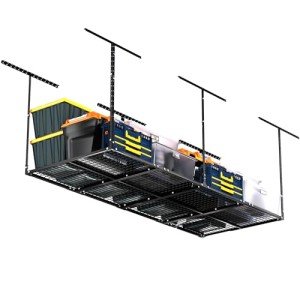
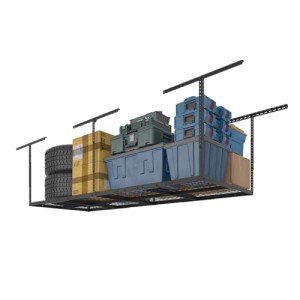
Heavy-Duty Garage Storage Rack
Fleximounts
Product Review Score
4.28 out of 5 stars
48 reviews$189.99 $119.99
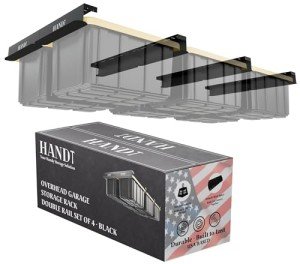
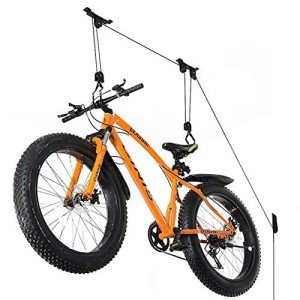
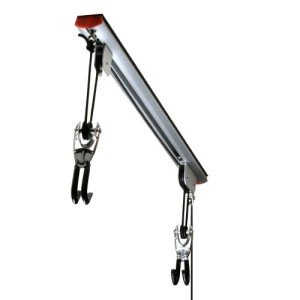
Bike and Ladder Lift
Rad Cycle Products
Product Review Score
4.24 out of 5 stars
112 reviews$39.99 $34.99
Maintenance & Troubleshooting
Regularly inspecting the torque on mounting bolts and the alignment of vertical down-posts prevents minor vibration-induced loosening from turning into a catastrophic structural collapse. Verifying that your load remains balanced across the wire decking is the simplest way to prevent the permanent bowing of the frame assembly.
Common Failure Modes
Mechanical stress and installation errors can compromise the integrity of overhead storage over time.
- Repeated loading and unloading cycles can lead to Cyclic Fatigue Failure in the primary support brackets; inspect brackets annually for hairline fractures or metal thinning.
- Exceeding the rated weight capacity often results in permanent Overload Deformation of the horizontal wire decking; use a scale to confirm total weight and ensure heavy bins are placed directly over the support beams.
- In vibration-prone environments, you may notice Joint Loosening where the frame segments connect; apply a medium-strength threadlocker to bolt threads during assembly to dampen the effects of vibration.
- Poorly distributed weight across the platform can cause significant Structural Warping of the steel frame; stagger your storage containers to keep the center of gravity neutralized across the rack.
- Hardware that is over-tightened during the initial installation may eventually suffer from Small Hardware Failure or shearing; use a calibrated torque wrench to meet manufacturer specifications without overstressing the bolts.
- Constant pressure on the mounting points can lead to Stress Cracking in the surrounding ceiling substrate; install spans of 2x4 "sister" boards if your drywall shows signs of compression or cracking near the lag bolts.
- In pulley-based systems, friction over time causes noticeable Abrasive Wear on the lifting cables; lubricate contact points with a dry silicone spray to reduce heat and fraying on high-friction surfaces.
Environmental Stress Factors
The atmosphere in your garage or attic plays a significant role in the degradation of storage hardware.
- Steel components without specialized coatings are highly susceptible to Corrosion in damp spaces; prioritize racks with galvanized or powder-coated finishes to block oxidation.
- Unfinished areas often suffer from a heavy Dust Load which can seize telescoping legs; wipe down adjustable parts twice a year to ensure the height-adjustment pins move freely.
- Exposure to unconditioned air in coastal regions can lead to Salt Exposure; rinse visible hardware with a damp cloth periodically to remove salt deposits that eat through protective layers.
- Rapid seasonal shifts create Temperature Extremes that cause metal expansion; re-tighten all major fasteners after the first major season change to account for thermal contraction.
Key Components
High-quality overhead storage relies on precision-engineered parts to maintain safety and ease of use.
- The foundation of the entire system is the Load Bearing Frame, which must be rated for the specific joist spacing of your ceiling.
- To secure the rack to the structure, a high-tensile Fastener System is required to resist the downward pull of the entire assembly.
- Many units feature a Structural Housing that prevents accidental side-impacts from dislodging the rack's primary support pins.
- Adjustable models utilize a Sliding Rail System, allowing the rack to clear garage door tracks or other ceiling obstructions.
- The exterior finish often includes a resilient Polymer Shell, which acts as a barrier against the humidity common in unconditioned garages.
- In advanced motorized units, the Motor Assembly uses gear-reduction to safely manage the lifting of heavy loads without manual winching.
Related Categories
If you are researching full-room setups, you may also want to review the failure expectations for these related devices:
- For heavy bicycles or ladders, consider adding Pulley Storage Lifts to easily hoist items toward the rafters.
- Organize your workspace floor by installing Pegboard Tool Organizers for quick access to frequently used hand tools.
- Keep your sports equipment and automotive fluids mobile with high-capacity Rolling Storage Shelves that tuck neatly under your ceiling racks.