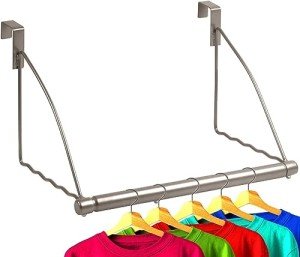
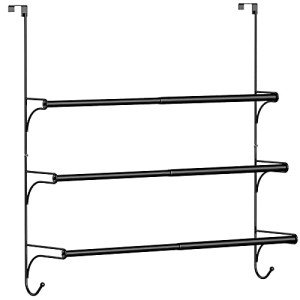
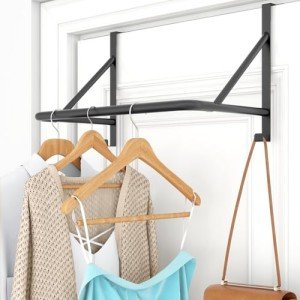
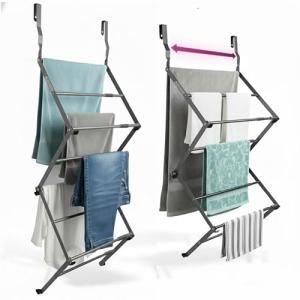
Maintenance & Troubleshooting
Regularly rotating your heaviest garments across different sections of the bar prevents localized stress and keeps the horizontal axis from developing a permanent downward bow. Checking bracket tension every few months stops vibration-induced loosening before it results in a catastrophic slip that gouges your door's finish.
Common Failure Modes
Over-door bars are subject to constant gravitational stress and repeated mechanical loading that can lead to several specific structural issues.
- Prevent Creep Deformation by unloading the bar for 24 hours once a week to allow the material fibers to recover from static tension.
- Reduce Abrasive Wear by using hangers with plastic-coated hooks, which minimize the friction that strips away factory protective finishes.
- Avoid Overload Deformation by strictly weighing wet laundry; a single saturated winter coat can exceed the safe torque limit of the mounting brackets.
- Stop Joint Loosening by applying a small amount of thread-locking fluid to assembly screws to dampen the vibrations caused by opening and closing the door.
- Counteract Cyclic Fatigue Failure by checking the bracket "elbows" for hairline cracks or whitening, which indicate the metal is reaching its limit.
- Fix Small Hardware Failure by replacing flimsy factory pins with high-tensile steel bolts if the width-adjustment mechanism begins to slip.
Environmental Stress Factors
The location of your door—whether in a humid laundry room or near a sunny window—impacts the longevity of the materials.
- Mitigate High Humidity Acceleration by applying a thin layer of car wax to non-stainless bars to create a moisture-resistant barrier in damp laundry rooms.
- Eliminate Dust Load by vacuuming the top of the door frame monthly, preventing abrasive particulates from getting trapped behind the mounting pads.
- Halt Corrosion by wiping the hardware down with a microfiber cloth after steaming clothes to remove the moisture that triggers oxidation.
Key Components
A high-quality over-door hanging bar relies on a synergy of specialized components to manage weight and protect your home's surfaces.
- The primary Load Bearing Frame should ideally be constructed from cold-rolled steel to maximize the weight-to-flex ratio.
- A secure Fastener System uses recessed housing to ensure that screws don't make contact with the door face during use.
- Inspect the Structural Housing for padding degradation; once the foam compresses fully, the metal bracket will begin to mar the wood.
- The Spring Elastic Component in tension models must be periodically checked for "memory loss," where the spring no longer exerts enough force to stay level.
- Look for a Polymer Shell that is UV-stabilized, ensuring the outer layer doesn't become brittle if the door is exposed to direct afternoon sunlight.
If you are looking for alternative ways to manage high-volume laundry or garment storage, you may also find our research on these categories helpful: