Maintenance & Troubleshooting
Preventing finish degradation is the most effective way to stop rust from compromising the thin wire mesh of your organizer. Regularly inspecting the friction points on sliding trays allows you to address coating wear before oxidation takes hold of the underlying steel.
Common Failure Modes
Even heavy-duty steel mesh can succumb to mechanical stress and material fatigue over time if not properly maintained.
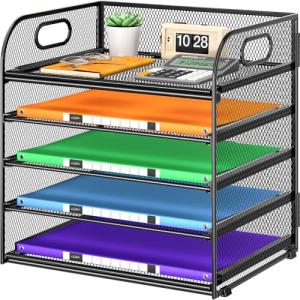
- Repeated loading of heavy reams of paper can lead to Structural Warping; rotate your heavy inventory every few months to redistribute the load and preserve tray alignment.
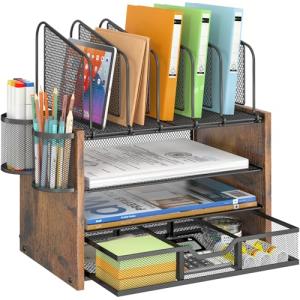
- Excessive force on drawer sliders or tiered sections often results in Joint Loosening at the spot-weld points; check for wobbling and reduce the weight on tiered sections if joints feel soft.
- Sliding metal components against one another without care frequently causes Abrasive Wear; apply a dry silicone lubricant to rails to prevent the metal-on-metal friction that strips protective finishes.
- Small mesh intersections may experience Vibration Crack Propagation near heavy printers; place a rubber dampening mat under the organizer to absorb high-frequency mechanical energy.
- Over-tightened accessory attachments can lead to Stress Cracking in reinforced corners; hand-tighten all screws only until snug to avoid fracturing the steel wire assembly.
- Impacts from heavy objects can cause Surface Scratching; use a matching enamel touch-up pen immediately to seal exposed raw metal from air and moisture.
Environmental Stress Factors
The longevity of metal office accessories is heavily influenced by the atmospheric conditions of your workspace.
- Placing metal organizers in damp basements or coastal offices triggers High Humidity Acceleration; maintain an indoor humidity level below 50% or choose stainless steel variants to avoid rapid oxidation.
- While the mesh allows airflow, flat surfaces within the unit still face a significant Dust Load; use compressed air or a soft microfiber cloth weekly to prevent moisture-trapping dust buildup in the mesh gaps.
- Using harsh industrial solvents for cleaning can create a Cleaner Compatibility Conflict; only use mild soap and water, as ammonia-based cleaners can dissolve and flake the powder finish.
Key Components
The engineering behind mesh organizers focuses on weight distribution and ventilation through specialized metal parts.
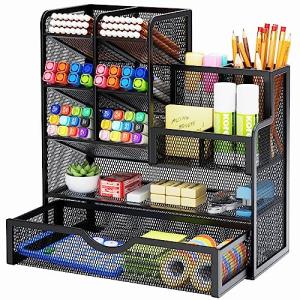
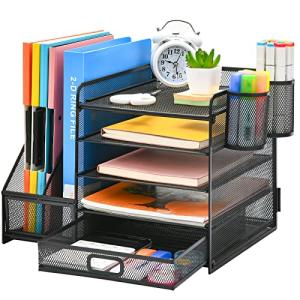
- The rigid Load Bearing Frame provides the essential skeleton; inspect this area for bowing as it is the primary indicator of exceeded weight limits.
- Small rubberized feet or screws serve as a Fastener System; ensure rubber feet are clean and tacky to prevent the unit from sliding and scratching your desk surface.
- Multi-tier units utilize a precision Sliding Rail System; keep these tracks free of debris to ensure smooth document access and prevent rail misalignment.
- The outer Structural Housing defines the footprint; look for signs of impact or denting that could interfere with internal drawer movement.
- A high-quality Surface Coating is applied to provide vital corrosion resistance; if the coating feels chalky, it may be degrading due to UV exposure or chemical cleaners.
Related Categories
If you are researching a full workstation upgrade, you may also want to review the failure expectations and maintenance needs for these related desktop categories: