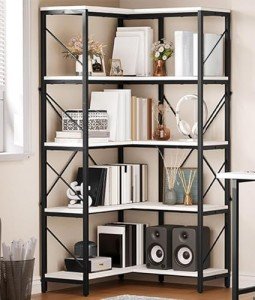
Maintenance & Troubleshooting
To prevent catastrophic joint failure, you must verify that your corner unit remains plumb and level every six months. Tightening cam locks and inspecting the edge banding for moisture intrusion will stop minor material fatigue from becoming a total structural collapse.
Common Failure Modes
Corner units face unique mechanical stresses due to their cantilevered nature and the tendency to overstuff deep angles.
- Prevent Structural Warping by placing the heaviest bins directly over the wall studs rather than at the unsupported front edge.
- Avoid Overload Deformation by adhering strictly to the manufacturer's weight rating, typically much lower for corner-spanning tiers.
- Stop Joint Loosening by applying a drop of wood glue to dowels or thread-locker to screws during the initial assembly.
- Counteract Moisture Swelling by ensuring at least a two-inch gap between the shelf and the back wall to allow for natural air circulation.
- Fix Small Hardware Failure by replacing stripped cam locks with high-torque steel fasteners to restore the unit's lateral rigidity.
- Reduce Abrasive Wear by using felt-bottomed bins to protect the laminate surface from high-friction movement.
- Mitigate Creep Deformation by selecting wire or solid wood over particle board for long-term storage of heavy seasonal equipment.
- Address Coating Peeling immediately with a matching touch-up kit to prevent humidity from penetrating the porous inner core.
Environmental Stress Factors
Closet environments are often poorly ventilated, leading to localized stressors that can degrade shelving materials.
- Fight High Humidity Acceleration by placing a desiccant canister in the corner to absorb the stagnant air that causes hardware oxidation.
- Prevent Pest Intrusion by sealing any gaps where the shelving meets the drywall, removing the dark voids insects use for nesting.
- Minimize Dust Load by performing a monthly wipe-down with a microfiber cloth to prevent grit from scratching the protective finish.
- Avoid Cleaner Compatibility Conflict by testing new polishes on an inconspicuous underside area to ensure they don't dissolve the factory seal.
Key Components
The reliability of a corner unit depends on the synergy between its load-bearing parts and its surface interfaces.
- The Load Bearing Frame must be anchored at multiple points on both intersecting walls to manage the twisting torque of the corner.
- A high-quality Fastener System uses toggle bolts or structural screws rather than simple plastic anchors to prevent "pull-out" failures.
- The Polymer Shell serves as a moisture barrier; ensure it is free of cracks that could harbor mold or mildew.
- Rigid Structural Housing is essential for modular units to prevent the vertical supports from bowing outward under heavy loads.
- The Adhesive Bond Layer on the edges should be inspected for lifting, which is a precursor to core-material rot.
- A Sliding Rail requires regular lubrication with dry silicone spray to maintain smooth operation without attracting dust.
Related Categories
If you are researching a full-room organization project, you may also want to review the failure expectations and hardware specs for these related storage categories: