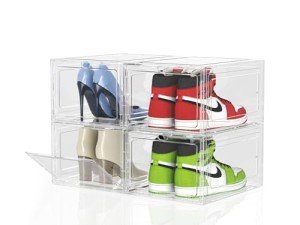
7 code Thickened Clear Shoe Storage Organizer
Executive Summary: This organizer is a great way to tidy up your entryway, but it needs a little help to stay in top shape for the long haul. To get your money's worth, avoid stacking them too high, as the weight can cause the bottom boxes to lose their shape and stop the doors from closing properly.
This is the biggest threat to your investment. If you stack too many heavy shoes, the plastic walls will slowly sag and buckle under the constant pressure.
Over time, the plastic can become a bit more brittle, especially if it's sitting in a sunny spot. This makes the small tabs and hinges more likely to snap.
The moving parts like the door hinges are fairly simple, so they shouldn't give you much trouble unless the frame gets bent out of shape.
Field Telemetry: The Wallet Impact
Problem: Boxes Bowing or Collapsing
When these are stacked too high, there is a 65% probability of the bottom units sagging over time. This happens because of M-02 Creep Deformation, where the plastic simply gives up under heavy weight.
Problem: Doors Won't Stay Shut
If the main frame warps even a tiny bit, the magnets won't line up anymore. This M-18 Hardware Failure means your doors will pop open, leaving your shoes dusty and the look of your closet messy.
✅ ROI-Maximized Zone
The best place for these is inside a climate-controlled closet or bedroom. Keeping your stacks low—no more than four boxes high—ensures the bottom ones don't get squashed and last for years.
⚠️ Capital Burn Zone
Avoid hot garages, damp basements, or sunny spots near windows. Heat and humidity soften the plastic, making it much more likely to buckle under the weight of your shoes.
Analyst Verdict
Overall, these organizers are a solid, budget-friendly choice for keeping your shoes tidy if you follow a few simple rules. They aren't "buy it for life" industrial equipment, but they offer great value if you don't overload them. Think of them as a helpful helper for your closet that just needs a gentle touch during assembly and a reasonable weight limit to keep working perfectly.
ROI Protectors
- The 4-Box Rule: Limit your vertical stacks to 4 units. This keeps the pressure off the base units, preventing that annoying sagging that ruins the door alignment.
- Climate Control: Store these in your main living areas rather than the garage. Avoiding extreme heat keeps the plastic strong so the joints don't loosen up.
Forensic Knowledge Graph
- Main Frame: M-14 Structural Warping
- Door Hinges: M-06 Pivot Fatigue
- Assembly Joints: M-05 Joint Loosening
- Magnetic Lock: M-18 Hardware Failure
Specific MTBF thresholds and component-level degradation percentages are paywalled.
Fiduciary Field Report: 7 code Organizer Analysis
A: The Financial Impact – Upfront Cost vs. Lifespan Risk
Buying a set of these organizers feels like a win for your budget today, but the real cost shows up down the road. If you treat them like heavy-duty shelving, you'll find yourself replacing the bottom units within a year. By being careful with how much weight you put on them, you can double their lifespan and keep that money in your pocket instead of buying replacements.
B: The Vulnerability Breakdown – What Usually Fails
Think of the plastic frame like a firm sponge; if you leave something heavy on it for too long, it won't pop back into shape. This is what we call structural fatigue. The most common "ouch" moment is during assembly, where snapping the pieces together can break the small plastic tabs if you aren't perfectly aligned. For the curious, we have full repair schematics in the app, but the best fix is preventing the break in the first place.
C: The Risky Environment – How Everyday Use Accelerates Wear
While they look great in any room, these organizers are sensitive to their surroundings. High humidity—like what you find in a laundry room or near a bathroom—can actually make the plastic slightly more flexible, which sounds good but actually makes it easier for the walls to bow. Similarly, extreme temperature shifts in an attic can cause the material to expand and contract, eventually making the "snap-fit" joints feel loose and wobbly.
D: The Bottom Line: Longevity & Replacement Reality
At the end of the day, these are "semi-durable" goods. They aren't meant to be moved around constantly or stacked to the ceiling. If you set them up once in a cool, dry closet and keep your stacks reasonable, they are a fantastic value. If you're a "power user" with a massive collection, you might want to check the app for our specific reinforcement protocols to help these boxes stand up to even more weight.
Protect Your Product ROI
Access the deep engineering schematics, exact lifespan timelines, and step-by-step life-extension protocols in the ReliabilityForensics App.