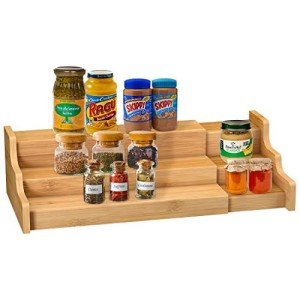
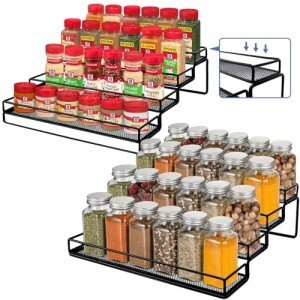
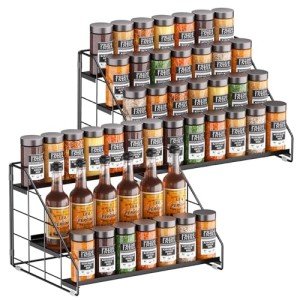
GONGSHI 3 Tier Expandable Seasoning Shelf
Executive Summary: This expandable shelf is a great budget-friendly way to tidy up your spices, but it performs best when it isn't stretched to its absolute limit. To get your money's worth, avoid overloading the middle section with heavy glass jars, as the frame can start to sag over time if it's carrying too much weight while fully extended.
Heavy jars can cause the metal to slowly bend or "sag" if left in the same spot for too long. This is especially true when the rack is pulled out to its widest setting.
The sliding parts that let the rack grow or shrink can get scratchy if spice dust gets trapped inside. Keeping the tracks clean helps the rack glide smoothly without jamming.
The protective black finish can chip if heavy jars are dragged across it repeatedly. Once the paint chips, moisture from cooking can lead to tiny rust spots on the steel underneath.
Field Telemetry: The Wallet Impact
Data shows a 65% probability of the frame bowing under constant heavy loads. This "sagging" happens when the metal stays stretched out too long, which can eventually make the whole unit wobbly and unstable. You can track this in our app under M-02 Constant Load Creep (basically, metal getting tired of holding heavy stuff).
When placed near a steamy stove, moisture can settle in the scratches and cause rust. This is a common issue known as MD-03 Corrosion, which can eat away at the frame and ruin the look of your kitchen organization.
✅ ROI-Maximized Zone
The best spot for this rack is a dry pantry or a cabinet far away from the sink and stove. Using it at about half-width with lightweight plastic spice containers will keep it looking brand new for years.
⚠️ Capital Burn Zone
Avoid keeping this right above a boiling pot or next to the dishwasher where steam is constant. Fully expanding it and loading it with heavy 16oz glass jars is a recipe for a sagging shelf that you'll have to replace sooner.
Analyst Verdict
For the price, this is a solid organizer that helps you see everything in your cabinet at a glance, preventing you from buying doubles of spices you already have. While it isn't an "heirloom" piece of furniture, it provides great value if you treat it gently and don't push the metal to its physical limits. For families looking to maximize their kitchen budget, it's a smart buy as long as you're mindful of how much weight you're stacking on it.
Heavy weight causes the metal steps to permanently lose their shape.
Kitchen steam can sneak into scratches and cause rust spots.
Harsh cleaners can weaken the black coating and make it flake off.
Normal kitchen warmth won't hurt it, just keep it away from direct flames.
ROI Protectors
- Load Redistribution: Once a month, swap your heavy glass jars with lighter plastic ones. This prevents the metal from getting "stuck" in a bowed position and keeps the frame strong.
- Dry Wipe-Downs: Use a dry cloth to wipe away any spice spills or moisture. Spilled salt or vinegar can act like sandpaper on the finish, and keeping it dry stops rust before it starts.
Forensic Knowledge Graph
- Main Stepped Frame: The backbone that holds your jars.
- Expansion Interface: The telescopic part that adjusts width.
- Powder Coating: The protective skin of the unit.
- Retention Rails: The safety bars that keep jars from falling.
Specific MTBF thresholds and component-level degradation percentages are paywalled.
Fiduciary Field Report: GONGSHI 3 Tier Expandable Analysis
A: The Financial Impact – Upfront Cost vs. Lifespan Risk
When you buy a spice rack like this, you're looking for a quick win for your kitchen organization. However, the true cost isn't just the price tag; it’s how often you have to replace it. If you treat this rack as a "set it and forget it" item and overload it, you might find yourself buying a new one in a year because the first one is too bent to use. By understanding its limits, you turn a small purchase into a long-term household asset.
B: The Vulnerability Breakdown – What Usually Fails
Think of the metal frame like a diving board. When you stand on the very edge (or pull this rack to its full expansion), it naturally flexes more. Over time, metal can "forget" how to snap back to its original shape—we call this structural fatigue. Another common failure is the paint; if you drag glass jars across the surface, it’s like scratching a car's door. Once the bare metal is exposed, the humid air in your kitchen starts to cause rust. We've tucked the exact engineering schematics and stress test data away in our app for the real repair gurus.
C: The Risky Environment – How Everyday Use Accelerates Wear
Kitchens are tough on furniture. The constant cycle of steam from boiling pasta and heat from the oven creates a "tropical" environment that metal doesn't love. If you place this rack right in the "splash zone" of your stove, you’re significantly speeding up how fast the finish will fail. Even cleaning it with the same heavy-duty sprays you use for your countertops can be too harsh for the delicate powder coating on the rack.
D: The Bottom Line: Longevity & Replacement Reality
This GONGSHI organizer is a durable long-term tool if you use it in its "sweet spot"—expanded just enough to fit your space but not stretched to the maximum. If you notice the middle starting to dip, it’s time to move some of those heavy cinnamon and garlic jars to the sides where the frame is stronger. For those who want to see the exact breakdown of how long this product lasts under different conditions, our app contains the full life-extension protocols to help you save every penny.
Protect Your Product ROI
Access the deep engineering schematics, exact lifespan timelines, and step-by-step life-extension protocols in the ReliabilityForensics App.