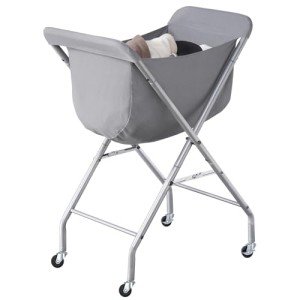
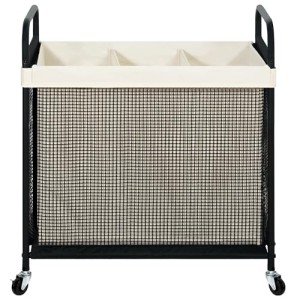
Maintenance & Troubleshooting
Preventing a total caster failure requires a monthly inspection of the wheel axles to clear away trapped fibers and hair that increase rotational heat. Applying a dry PTFE lubricant to the bearing race twice a year will prevent the metal-on-metal grinding that eventually leads to frame misalignment.
Common Failure Modes
Over time, the mechanical nature of mobile storage leads to specific physical degradations that can impede smooth operation.
- Repeated movement over uneven surfaces often results in Bearing Wear Rotational Friction; resolve this by cleaning axles and applying a dry lubricant to restore smooth movement.
- Heavy loads of wet towels can lead to Overload Deformation; prevent permanent frame warping by distributing weight evenly and avoiding capacity limits.
- Frequent dragging of the fabric liner against the frame causes Textile Fiber Thinning; reinforce contact points with adhesive moleskin or adjust the liner tension to stop abrasive rubbing.
- Constant vibration from rolling can lead to Joint Loosening; perform a quarterly check to retighten all bolts and locknuts to maintain structural rigidity.
- In humid laundry rooms, metal fasteners may suffer from Corrosion; swap out standard steel nuts for stainless steel hardware or coat existing fasteners in a clear rust inhibitor.
- If the hamper is struck against door frames, it might experience Impact Fracture; protect rigid plastic components by installing rubber bumpers at the widest points of the frame.
- The repeated removal and reattachment of bags often leads to Stitch Failure; prolong liner life by hand-reinforcing the top hem with heavy-duty nylon thread at high-stress points.
Environmental Stress Factors
The environment in which you store and use your hamper dictates how quickly its materials will break down.
- Laundry rooms are prone to High Humidity Acceleration; use a dehumidifier in the area to prevent the microbial breakdown of fabric and the oxidation of metal frames.
- Wheels and casters are particularly vulnerable to Dust Load; use a vacuum crevice tool to clear the caster housing weekly to prevent dust from packing into the bearing race.
- In homes with animals, Pet Hair Clogging creates significant friction; use a pair of tweezers or a seam ripper to remove hair wraps from the wheel axles before they melt into the plastic.
Key Components
A high-quality rolling hamper relies on several critical engineered parts to ensure longevity and ease of use.
- The primary strength of the unit comes from its Load Bearing Frame; check for tubular steel construction which offers better weight-to-strength ratios than flat-bar designs.
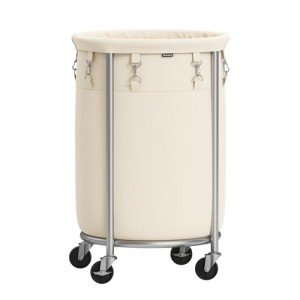
- Effortless 360-degree movement is made possible by the Rotational Drive Assembly; ensure the swivel plate is ball-bearing driven rather than a simple plastic-on-plastic pivot.
- To keep the hamper mobile yet stable, the Bearing System reduces friction; look for sealed bearings to keep out environmental debris and ensure silent operation.
- The structural pieces are held together by a robust Fastener System; prioritize models that use nylon-insert lock nuts which are resistant to vibration-induced loosening.
- Many high-end models feature a Polymer Shell exterior; check for high-density polyethylene (HDPE) which resists chemical staining and impact cracking better than standard plastic.
- Removable liners often utilize an Upholstery Fabric Layer; look for denier ratings of 600 or higher to ensure the weave can handle the weight of damp laundry without stretching.
Related Categories
If you are researching full-room setups, you may also want to review the failure expectations for these related devices: