Maintenance & Troubleshooting
Proactive lubrication of the telescopic rails with a dry Teflon spray prevents the metal-on-metal grinding that leads to seized drawers. Periodically checking the torque on internal cam-locks ensures that the bench remains a rigid structural unit rather than a collection of independent, wobbling panels.
Common Failure Modes
Daily use of storage seating can lead to mechanical fatigue and structural shifts that compromise the unit's utility.
- Heavy daily use often leads to sliding track wear, causing drawers to stick. Prevention: Apply a dry-film lubricant to the rails every six months to minimize friction and prevent bearing flat-spots.
- Repeated weight application on the seating surface can result in joint loosening, which manifests as wobbling. Solution: Retighten all assembly bolts and cam-locks 30 days after initial setup and annually thereafter to maintain structural rigidity.
- Exceeding the recommended weight capacity frequently causes overload deformation, potentially bowing the drawer bottoms. Prevention: Install a secondary support cleat or "stiffener" to the underside of the drawer panel if storing heavy items like boots or tools.
- Frequent opening and closing cycles contribute to cyclic fatigue failure, weakening metal hardware. Prevention: Avoid "slamming" drawers; install soft-close dampers to reduce the impact force on the metal mounting brackets.
- Poorly distributed loads may lead to small hardware failure, where screws strip away from the housing. Solution: Use wood glue or toothpicks to fill stripped screw holes before re-driving fasteners to ensure a permanent mechanical bond.
- For units with integrated seating pads, you may notice cushion collapse where the internal foam loses its resilience. Solution: Rotate the bench or the cushion frequently to prevent a permanent compression set in a single localized area.
Environmental Stress Factors
The placement of your bench significantly impacts the material stability and longevity of its moving parts.
- Placing furniture in entryways exposes it to high humidity acceleration, which can cause wood to swell. Prevention: Maintain a minimum 2-inch gap between the bench and the wall to allow for airflow and prevent moisture trapping.
- Accumulated grit from the floor leads to dust load within the tracks, increasing friction. Prevention: Vacuum out the drawer slides monthly to remove abrasive particles that can strip the factory-applied grease.
- Constant sunlight from nearby windows can trigger high UV exposure, resulting in faded finishes. Prevention: Use a UV-protectant furniture wax or position the bench out of the direct solar path to preserve the structural integrity of the fibers.
Key Components
A high-quality bench relies on several critical parts working in harmony to provide both comfort and organization.
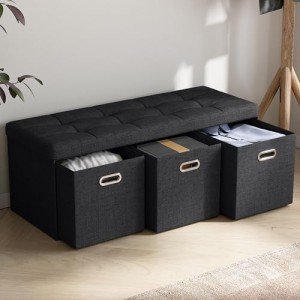
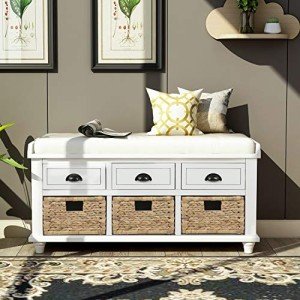
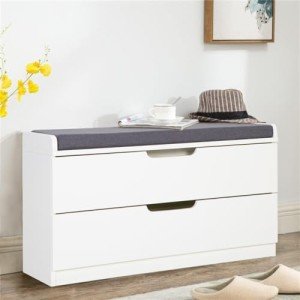
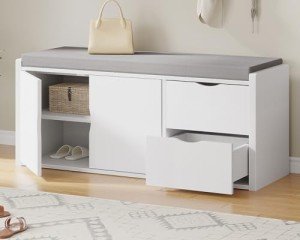
- The core of the unit is the load bearing frame, which must support both the seated user and stored items. Tech Tip: Inspect the thickness of the vertical gables; these are the primary points that prevent the bench from "racking" or leaning.
- Smooth operation is facilitated by the sliding rail system, ensuring the drawers move effortlessly. Tech Tip: Look for full-extension, ball-bearing slides rather than plastic rollers for significantly higher load tolerances.
- To maintain structural stability under pressure, the fastener system keeps all panels securely locked in place. Tech Tip: Opt for units using steel-to-steel fasteners rather than screws driven directly into raw particleboard.
- The outer structural housing provides the aesthetic finish while protecting the internal contents. Tech Tip: Check that the housing is properly sealed to prevent liquid spills from soaking into the porous core of the panels.
- For added comfort, the top often features an upholstery fabric layer. Tech Tip: Choose fabrics with a high "double-rub" count to ensure the material doesn't pill or tear under the friction of daily use.
Related Categories
If you are researching full-room setups, you may also want to review the failure expectations for these related devices:
- For smaller hallways where floor space is limited, shoe storage cabinets offer a slimmer profile with different hinge-stress profiles.
- You can add versatile seating and hidden storage to a living room using storage benches that utilize flip-top lid mechanisms instead of drawers.
- To keep your floor clear of clutter, try wall mounted coat racks which involve unique wall-anchor pull-out considerations.