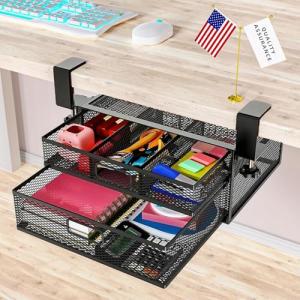
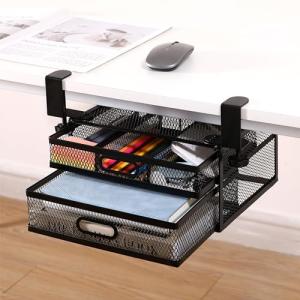
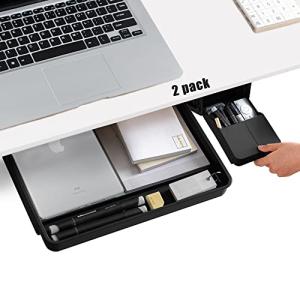
Officemate Medium Self-Adhesive Under Desk Drawer (22532)
Executive Summary: This budget-friendly drawer is a great way to clear off your desk, but its lifespan depends entirely on how much weight you throw in it and how clean your desk is before you stick it on. To keep your money from going down the drain, stick to light items like pens and pads, as heavy loads can cause the sticky pads to give up and drop your stuff on the floor.
Plastic rubbing on plastic can make the drawer feel "crunchy" or stuck over time. This happens because there aren't any metal wheels to keep things moving smoothly.
The sticky strips bear all the weight, and too much pressure makes them pull away from the desk. It’s the most common way this product ends up in the trash.
Over time, the plastic frame might start to sag or bow if it's always holding heavy items. This warping can eventually lead to tiny cracks near the mounting points.
Field Telemetry: The Wallet Impact
Problem: Drawer Falls Off Entirely
Our data shows an 85% failure rate for the sticky bond when the drawer is pushed to its limit. This is usually caused by MD-08 Adhesive Bond Failure, which means the glue just can't hold onto the desk anymore.
Problem: Sticky or Difficult Sliding
Many users find the drawer gets harder to open after a few months of daily use. This is down to M-16 Sliding Track Wear, where dust and friction grind down the plastic tracks.
✅ ROI-Maximized Zone
This drawer is happiest in a temperature-controlled home office on a smooth, flat surface like a metal or finished wood desk. It's perfect for light stuff like post-it notes, charging cables, and your favorite pens.
⚠️ Capital Burn Zone
Avoid using this in a hot garage or a humid basement, as heat makes the glue soft and weak. Also, don't use it to store heavy tools or large stacks of heavy coins that will strain the plastic frame.
Analyst Verdict
For the price of a few lattes, this is a decent "quick fix" for a messy desk, but don't expect it to be a family heirloom. It's built as a budget-tier organizer, meaning the materials are chosen for low cost rather than long-term endurance. If you follow the setup rules and keep the weight light, it’ll serve you well, but once that adhesive starts to sag, it's usually game over for the unit.
ROI Protectors
- Deep Clean Before Sticking: Use rubbing alcohol to degrease the underside of your desk before installing. This ensures the glue gets a "forever grip" rather than sticking to dust and oils.
- Lube the Tracks: A tiny bit of dry silicone spray or even a rub with a candle (wax) on the sliding tracks every six months keeps it opening like butter without attracting messy dust.
Forensic Knowledge Graph
- • Main Body: M-14 Structural Warping (bending under weight)
- • Sticky Pads: MD-08 Adhesive Bond Failure (glue letting go)
- • Slide Rails: M-16 Sliding Track Wear (gritty friction)
Specific MTBF thresholds and component-level degradation percentages are paywalled.
Fiduciary Field Report: Officemate 22532 Analysis
A: The Financial Impact – Upfront Cost vs. Lifespan Risk
When you're looking at a budget-friendly organizer like this Officemate drawer, the price tag is very tempting. However, the real cost isn't just the checkout price; it's the risk of having to buy a replacement in six months. Since this uses adhesive instead of screws, its "rent" on the bottom of your desk is paid in weight. If you treat it like a heavy-duty drawer, the "eviction" happens when the adhesive fails, potentially damaging whatever was inside when it hits the floor. It’s a classic case of getting exactly what you pay for—high convenience with a side of caution.
B: The Vulnerability Breakdown – What Usually Fails
Think of the adhesive strips like a group of friends holding up a heavy couch; eventually, their grip is going to slip. Most of these units fail because the sticky bond can't handle the constant downward pull. We also see "track fatigue," where the plastic tracks start to wear down because there are no ball bearings to smooth out the movement. It’s like walking on a carpet versus walking on a hardwood floor; there’s just more resistance. For those who want the full technical blueprints and exact repair steps, we’ve got those locked away in the app for your "handy" weekend projects.
C: The Risky Environment – How Everyday Use Accelerates Wear
Your environment plays a huge role in how long this drawer lasts. If your desk is near a sunny window or a space heater, that heat can actually "melt" the glue just enough to let it slide right off. Similarly, if you live in a dusty area, that grit gets into the tracks and acts like sandpaper, grinding away the plastic every time you check for a pen. It’s not that the product is bad—it’s just that it has very specific "happy places" where it works best. Using it outside of those conditions is like wearing flip-flops in a snowstorm; it's just not going to end well.
D: The Bottom Line: Longevity & Replacement Reality
In the world of household goods, this is what we call a "high-utility consumable." It’s incredibly useful for organizing your life right now, but it isn't meant to last forever. You should expect a solid 1–3 years of life if you’re careful, but once it starts to sag, it's safer to replace it than to try and "super glue" it back on. To get the most bang for your buck, keep the load light and the tracks clean. For exact timelines on when your specific model might need a refresh, check out the life-extension protocols in our app.
Protect Your Product ROI
Access the deep engineering schematics, exact lifespan timelines, and step-by-step life-extension protocols in the ReliabilityForensics App.