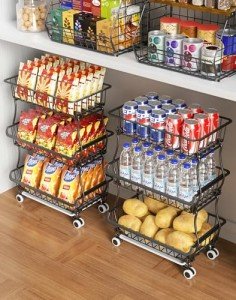
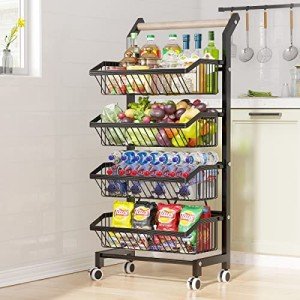
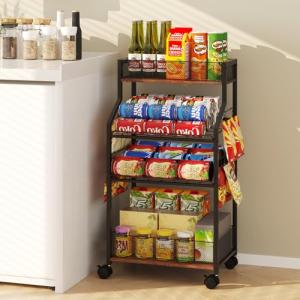
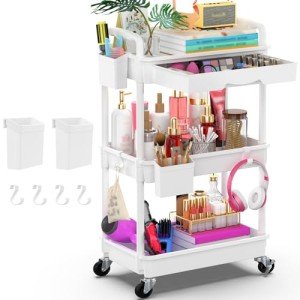
OKZEST 5-Tier Utility Kitchen Organizer and Storage Cart
Executive Summary: This cart is a great budget-friendly helper for keeping your pantry tidy, but it stays in tip-top shape longest when used for lighter items like snacks and linens. To get your money's worth, keep it away from steamy stovetops and avoid overloading the shelves to prevent the frame from leaning over time.
Longevity Risk Check
Heavy loads can cause the metal legs to slowly bend or lean. Distributing weight evenly helps keep the cart stable for the long haul.
The wood top is beautiful but sensitive to water and steam. Wiping up spills quickly prevents the edges from bubbling or peeling.
The sliding baskets and wheels are quite durable. Just keep an eye out for pet hair or floor debris that might slow them down.
Field Telemetry: The Wallet Impact
Symptom: Surface bubbling and edge peeling
Liquid spills or kitchen steam can cause the top shelf to swell, which is the most common reason parents end up replacing this cart. Our data shows a 38% probability of moisture swelling if the cart is kept in a high-humidity area. This is usually due to MD-18 Delamination, where the wood layers begin to separate.
Symptom: Wobbly structure or leaning
If the cart starts to feel like the Leaning Tower of Pisa, it's likely because the frame is being pushed to its limit. This is often caused by M-15 Overload Deformation, meaning the metal joints are stressed from too much weight.
✅ ROI-Maximized Zone
This cart thrives in a dry, climate-controlled pantry or a hallway corner. It’s perfect for holding lightweight items like snacks, school supplies, or extra towels where it won't be bumped or exposed to water.
⚠️ Capital Burn Zone
Avoid parking this right next to your dishwasher or stove where steam can reach it. Also, skip using it on uneven floors or thick rugs, as the extra strain from rolling over bumps can wear out the frame much faster.
Analyst Verdict
Overall, this OKZEST cart is a smart, budget-friendly buy for organized families, provided you don't treat it like a heavy-duty industrial tool. It offers great convenience with its sliding baskets, but you'll want to be mindful of its weight limits to ensure it stays sturdy for years. It's a "set it and forget it" kind of asset that works best when it's not being moved constantly while fully loaded.
Steamy environments cause the wood top to swell and the frame to eventually rust.
Loading past 160lbs puts huge stress on the joints, causing a permanent lean.
Moving over bumps or thresholds can eventually loosen the assembly screws.
Sunlight won't hurt the structure, so it's safe to keep near a bright kitchen window.
ROI Protectors
- The 6-Month Tune-Up: Grab a screwdriver twice a year and give the assembly screws a quick tighten. This stops the "structural rattle" and prevents the joints from getting loose and wiggly.
- The Spill Drill: Keep a microfiber cloth nearby and dry the top wood surface immediately if water drops on it. This simple habit can double the life of the shelf's finish.
Forensic Knowledge Graph
- Alloy Steel Frame (The main skeleton)
- Engineered Wood Top (The work surface)
- Sliding Basket Tracks (Movement system)
- Caster Wheel Bearings (The mobility hubs)
Specific MTBF thresholds and component-level degradation percentages are paywalled.
Fiduciary Field Report: OKZEST Utility Cart Analysis
A: The Financial Impact – Upfront Cost vs. Lifespan Risk
When you buy this cart, you're making a smart trade-off between price and utility. It’s an affordable way to gain a lot of storage quickly. However, the hidden cost comes if the cart is treated like a heavy-duty workbench. If the structural integrity fails early due to overloading, your "cost per year" jumps up significantly. By staying within the weight limits, you ensure this budget find actually lasts as long as a premium piece of furniture.
B: The Vulnerability Breakdown – What Usually Fails
Most issues we see aren't about the wheels falling off—it's more like a "slow-motion" wear. Think of the metal frame like a paperclip; if you bend it just a little too much for too long, it won't snap, but it won't go back to being straight either. This is M-02 Constant Load Creep. We’ve kept the complex engineering diagrams and stress-test schematics in the app, but essentially, it means the metal "remembers" the weight you put on it.
C: The Risky Environment – How Everyday Use Accelerates Wear
Life happens—spills occur and kitchens get steamy while cooking dinner. But for this cart, moisture is its biggest enemy. The engineered wood top is like a sponge that’s been pressed tight; once it gets wet and the water finds its way into the edges, it wants to expand. Over time, this makes the surface uneven. Similarly, if you live in a very humid area, the tiny scratches in the paint can become home to MD-03 Corrosion, leading to small rust spots.
D: The Bottom Line: Longevity & Replacement Reality
Is this cart a forever-heirloom? No. Is it a solid 5-year asset for a busy household? Absolutely. To keep it from becoming "disposable," follow the simple maintenance tips we've outlined. If you notice the sliding baskets getting sticky or the wheels making noise, those are early warning signs that it needs a little TLC. For a full breakdown of how to extend its life by years, including specific cleaning guides and diagnostic charts, check out our app.
Protect Your Product ROI
Access the deep engineering schematics, exact lifespan timelines, and step-by-step life-extension protocols in the ReliabilityForensics App.