Maintenance & Troubleshooting
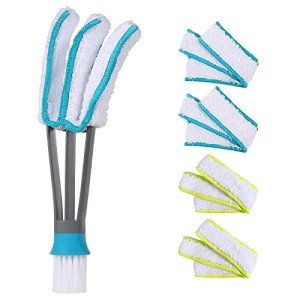
To prevent premature joint failure, avoid over-compressing the cleaning arms when navigating non-standard blind thicknesses. Regularly flushing microfiber sleeves in lukewarm water prevents the accumulation of abrasive grit that can lead to microscopic surface scratching on painted slats.
Common Failure Modes
Over time, the mechanical and material integrity of cleaning tools can diminish due to repetitive use and chemical exposure.
- Mitigate Abrasive Wear by rotating cleaning pads frequently and replacing them once the fibers lose their loft to ensure consistent particulate trapping.
- Prevent Stress Cracking by storing tools in a dedicated clip rather than at the bottom of a heavy utility bucket where they may be crushed.
- Address Joint Loosening by inspecting the tension of the central pivot and avoiding excessive force on the outward stroke during vent cleaning.
- Avoid Coating Peeling by using only water or pH-neutral cleaners, as aggressive solvents can dissolve the protective finish on plastic tool handles.
- Slow down Textile Fiber Thinning by air-drying microfiber attachments; high-heat cycles in a dryer will melt the synthetic hooks and ruin the electrostatic charge.
- Counter Elastomer Hardening by keeping the tool away from direct sunlight, which prevents UV rays from leaching the plasticizers that keep the grip flexible.
- Stop Overload Deformation by using a specialized stiff-bristle brush for heavy metal vents rather than forcing a flexible blind cleaner into rigid louvers.
- Inhibit Mold Growth by ensuring all porous heads are completely dry before placing them in a closed storage caddy or cabinet.
Environmental Stress Factors
The conditions in which you store and use your cleaning implements directly affect their long-term durability and effectiveness.
- Protect against Temperature Extremes by keeping your toolkit in a climate-controlled pantry, preventing the rapid expansion and contraction that shatters plastic frames.
- Manage a heavy Dust Load by tapping out the tool outdoors between slats to prevent grit from acting as an abrasive against the blind's finish.
- Reduce Pet Hair Clogging by using a fine-tooth comb to clear bristles, ensuring the tool can still reach deep into the recesses of HVAC registers.
- Resolve a Cleaner Compatibility Conflict by wiping kitchen vents with a degreaser before using the tool, preventing oils from dissolving the duster's internal adhesives.
Key Components
Each part of a vent or blind cleaner is designed to balance flexibility with the strength required for deep cleaning.
- The Structural Housing acts as the backbone; look for reinforced ribbing in the plastic to ensure the arms don't snap under lateral load.
- The Active Ingredient in high-quality microfiber utilizes split-fiber technology to mechanically lift dust without needing chemical sprays.
- A robust Fastener System, such as high-tension snaps or hook-and-loop strips, keeps the cleaning sleeve from sliding off during deep-vent insertion.
- The Polymer Shell should be constructed from impact-resistant materials to survive accidental drops on tile or hardwood floors.
- The Carrier Base provides the internal cushioning that allows the cleaning head to contour to curved blind slats for better surface contact.
- The Spring Elastic Component is vital for multi-slat tools; ensure it offers enough tension to "grip" the slats without being so stiff that it causes arm fatigue.
Related Categories
If you are researching a complete home maintenance strategy, you may also wish to review the hardware durability expectations for these related categories: